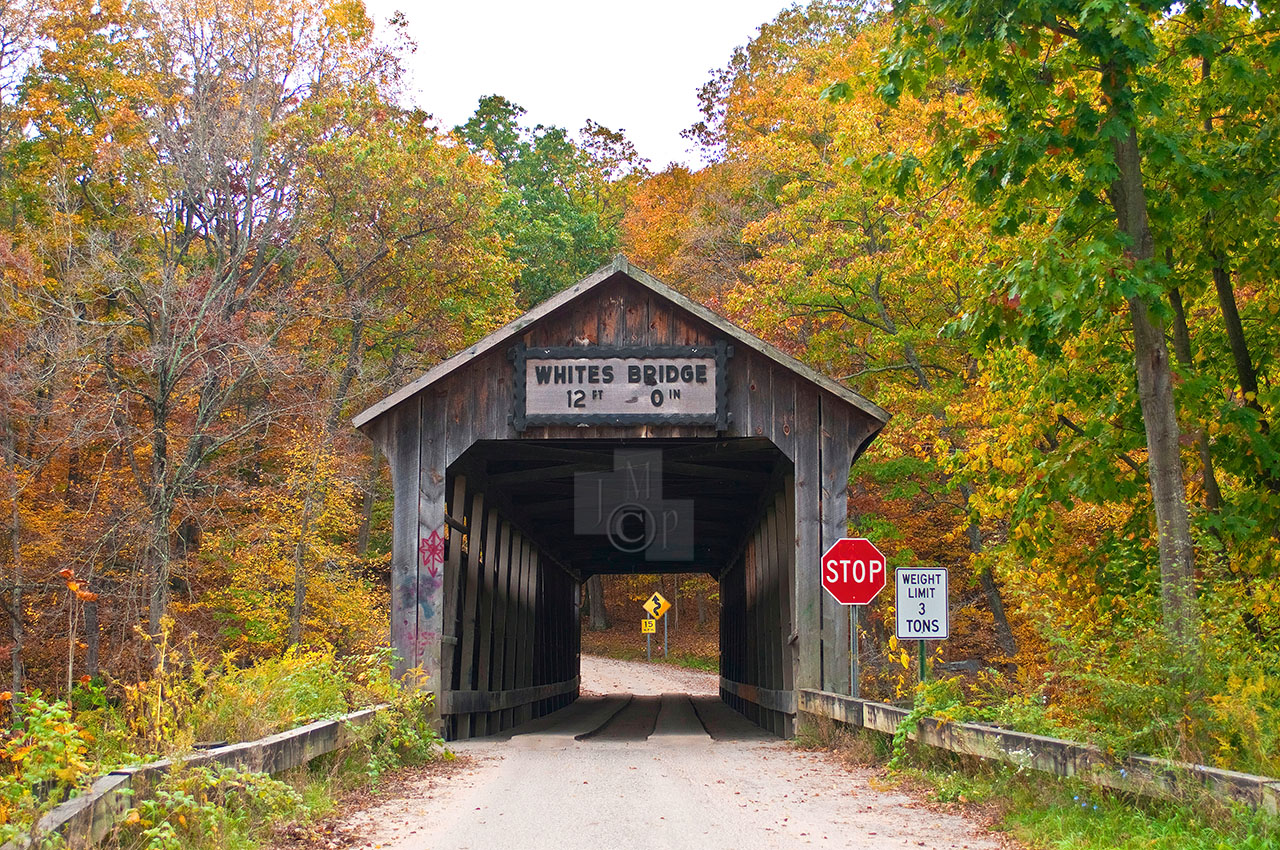
This beautiful bridge no longer exists. After serving it's purpose crossing the Flat river since 1870 near Smyrna Michigan an arsonist burnt it down in July 2013. These Photos were taken a few years earlier.
It took until 2021 to raise the money, and rebuild the bridge - which I haven't seen. A wiki page contains more of the story here https://en.wikipedia.org/wiki/Whites_Bridge
From the north looking to the south during peak fall colors
Looking through the single lane bridge towards the hills south of the bridge
Looking north from the south side of the bridge in winter
Infrared does interesting things to a blue sky, or green foliage.
The Red door is a cobbled together collection of pine boards, glass, trim, antique hardware, improvised locks, and ancient red paint. It opens onto a torturous deck that is renown for producing slivers that resemble chef's knives. A fact to which I and my big toe have been a victim.
Its red paint has witnessed countless hours of sun, wave lapping sounds, and cicada songs.
In February I accidentally (long story) purchased a bucket list lens - the Nikkor 200mm f2.0 AI. In March I added a new to me camera - the Canon 5DSR. In May I found a new way to scan film negatives that results in perfect color. That prompted me to purchase an "Essential Film Holder" from an engineer working out of his kitchen with his wife in London, because they are swamped with orders. Next (there is always a next) I needed software to convert the scans to get that perfect color - enter "Negative Lab Pro". Which necessitated a used Nikon PG-2 focusing stage, a CRI 95 light panel, plus wireless triggers for the cameras. Straight up it has triggered a renewed energy in my passion for photography resulting in me shooting more images in the last seven months than the previous two years.
This is the new way to scan negatives. You use a DSLR to shoot the negative. Pictured here is the Canon 5DSR (50 megapixel), a 50mm f2.8_Schneider Componon-S enlarging lens (proved better than my other four macro lenses) plus a set of Nikon "K" tubes. The Essential Film Holder, with a light panel providing the illumination. (not pictured is the wireless trigger).
Since an enlarging lens does not have a focusing helicoil that is why a Nikon PG-2 focusing stage was required. Here are some of the results. (click photos for larger versions)
Notice in this 100% crop that even the grains of the Fuji iso 400 film are in perfect focus. No sharpening has been applied, or noise reduction.
When I was a boy in northern Michigan's woods in the 1960s I met this amazing veterinarian named Max. Max had more cats and dogs than anyone I knew. He loved to build things, and problem solve. His hands were all balled up and crooked from arthritis, and Max smoked pipes constantly. Max loved his wife Beryl, and out of his massive workshop she requested he make something practical like plates. Instead of more things for the shop or other people.
Max's tool shop was two stories high measuring 30' x 60', and he had built solid cherry cabinets to hold his tools. It smelled of smoke and wood as did Max.
So Max made Beryl some plates, and she said..."I was thinking of something oval".
I wasn't there for his reaction, but I am sure he had a twinkle in his eye. A challenge, and a problem to be solved. "How could I make identical oval plates?" His quest began.
Max went to work building a machine that would create identical oval wood plates using a router, and an acme screw hand crank.